



Nigeria already operates one of the world’s largest informal private-energy markets. Millions of households self-finance electricity daily through petrol, diesel, generators, and ad hoc backup systems. The question is no longer whether Nigerians can pay for energy. The question is whether those fragmented expenditures can be redirected into structured, financeable distributed infrastructure.
Let’s Talk Numbers
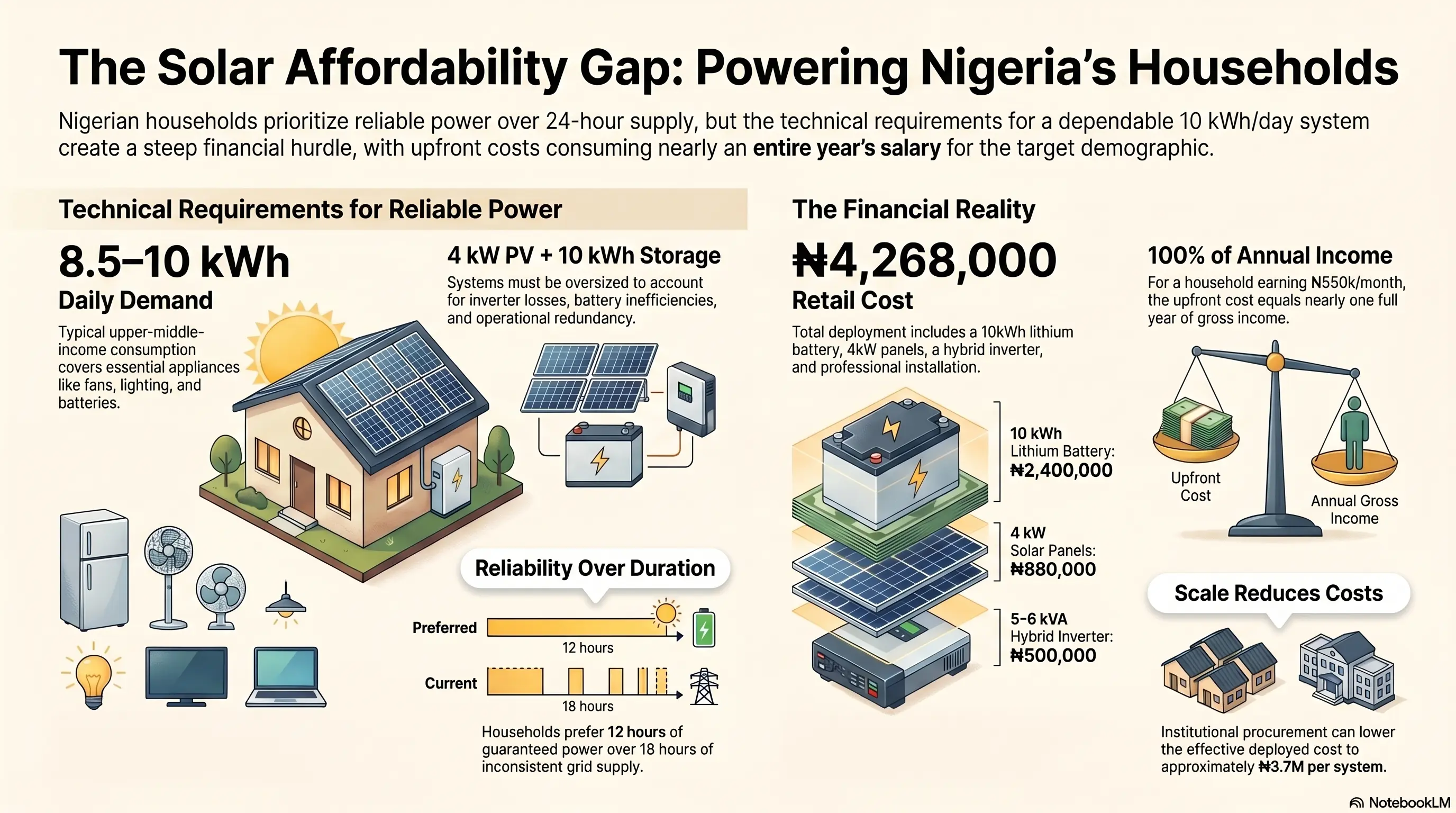
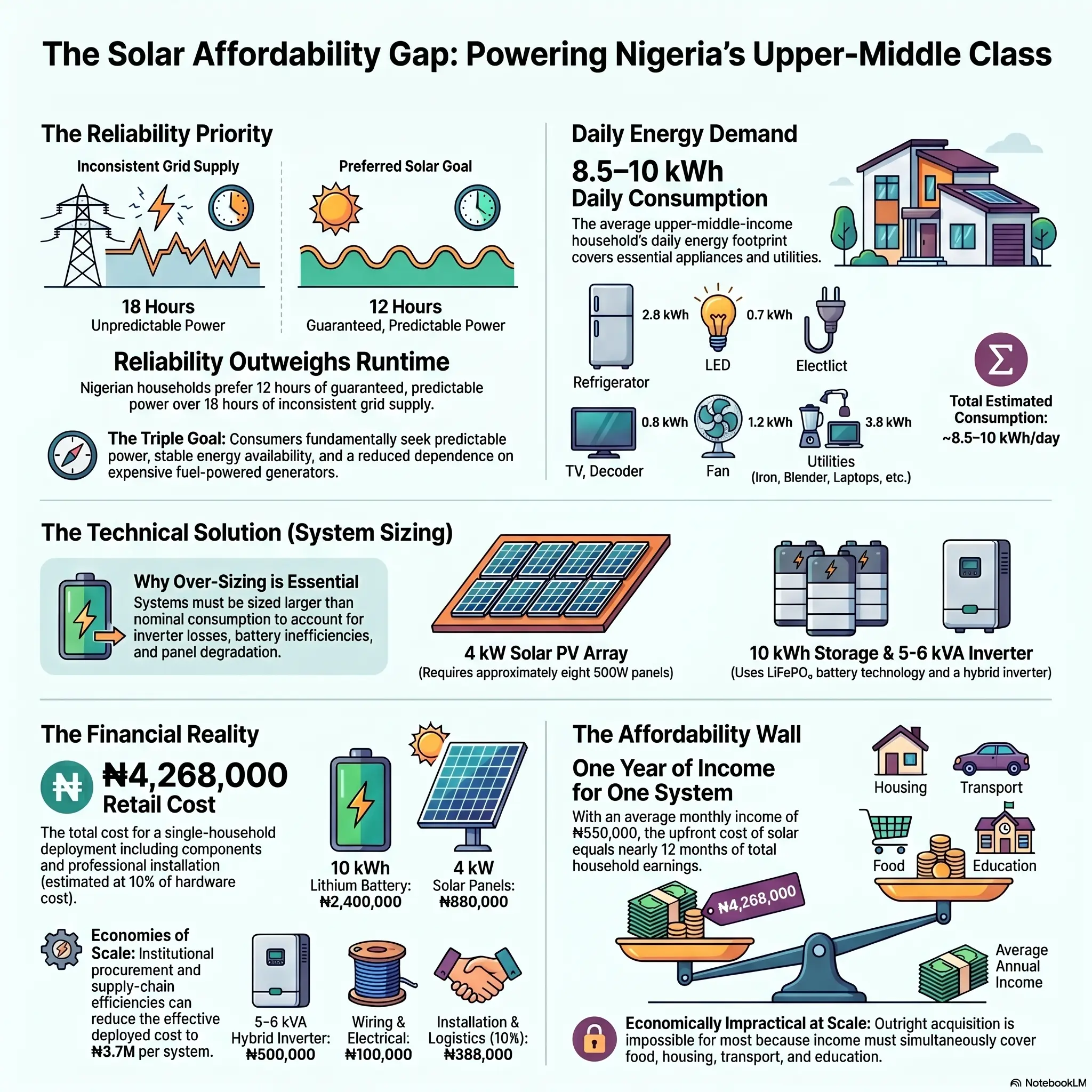
The average Nigerian household consumes about 8 kWh of electricity daily. This typically covers:
| Appliances | Estimated Daily Consumption |
|---|---|
| Refrigerator | 2.0 kWh |
| Lighting (LED bulbs across rooms) | 0.7 kWh |
| TV + Decoder | 0.8 kWh |
| Fans | 1.2 kWh |
| Utilities (Iron, Blender, Phones, Laptops, etc) | 3.8 kWh |
| Total | 8.5kWh/day |
∴Total Estimated Consumption : ≈ 8.5kWh/day
To reliably power this using Solar, we don’t size the system at exactly 8.5kWh, We must account for:
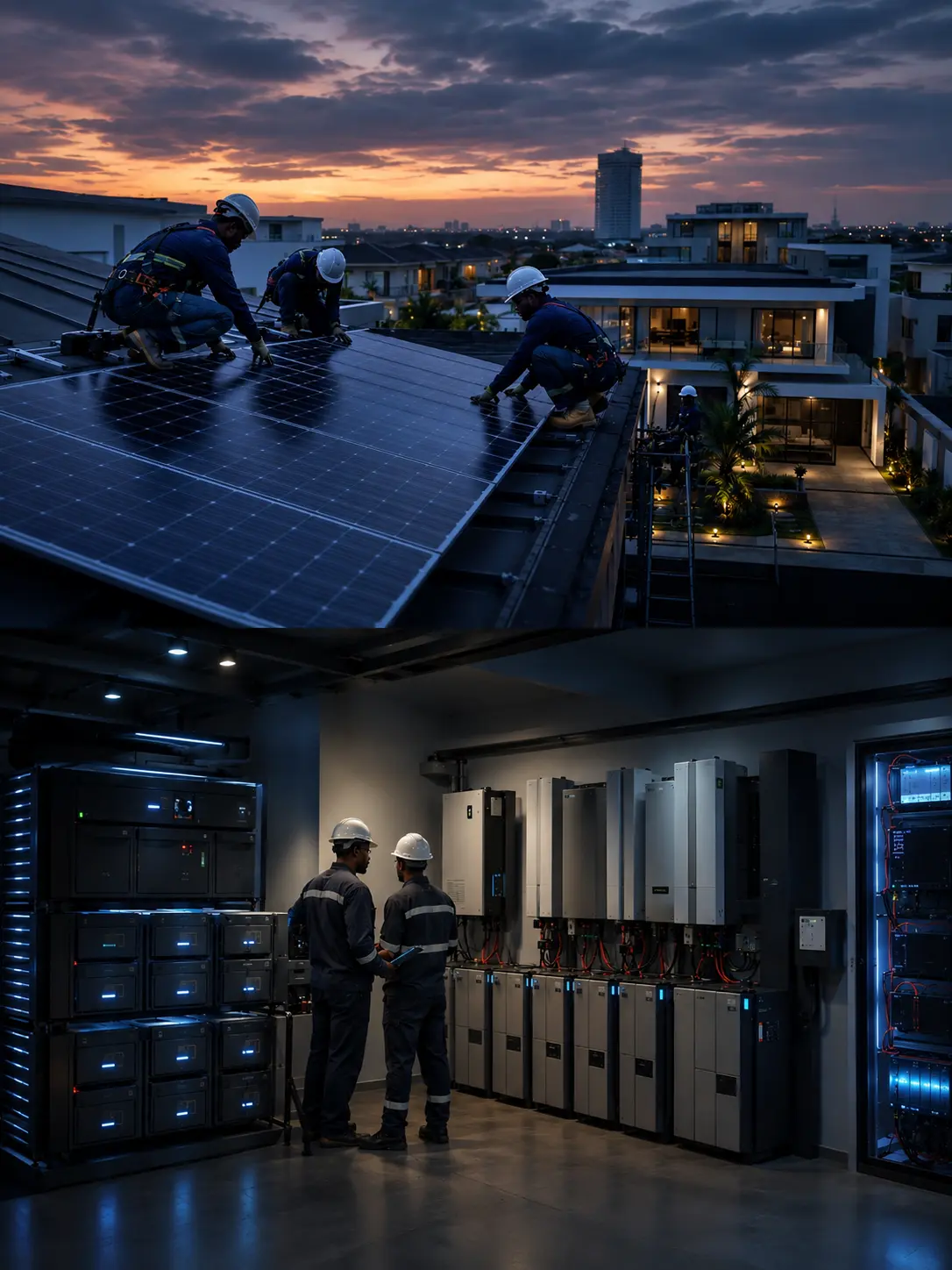
A practical residential configuration therefore includes:
| Component | Specification |
|---|---|
| Solar Panels | ~8 × 500W Panels(4kW) |
| Battery Storage | 10 kWh LiFePO Battery |
| Inverter | 5–6 kVA Hybrid Inverter |
| Component | Cost |
|---|---|
| 10 kWh Lithium Battery | ₦2,400,000 |
| 4 kW Solar Panels | ₦880,000(₦110,000 per 500W) |
| 5–6 kVA Hybrid Inverter | ₦500,000 |
| Wiring & Electrical Components | ₦100,000 |
Subtotal: ₦3,880,000
Professional installation, configuration, mounting infrastructure, logistics, commissioning, and deployment overhead are estimated at: 10% of subtotal(₦388,000)
∴Installation Cost : ₦388,000
Total Retail Deployment Cost Per Household(Subtotal + Installation Cost) :
₦3,880,000 + ₦388,000 ≈ ₦4,268,000
At institutional scale, procurement and supply-chain efficiencies can reduce deployment costs by roughly 15%.
Deployment Cost ≈ ₦3.7M per system
The average upper-middle-income Nigerian household earns approximately:₦550,000 monthly.
This means a typical household is effectively being asked to commit nearly one full year of household income upfront, simply to secure stable electricity access. While simultaneously covering: housing, food, transportation, education, healthcare,and broader living expenses.
This makes outright solar acquisition economically impractical.
The only financially scalable pathway for residential solar adoption in Nigeria is, Pay-As-You-Go (PAYG) Solar Financing.
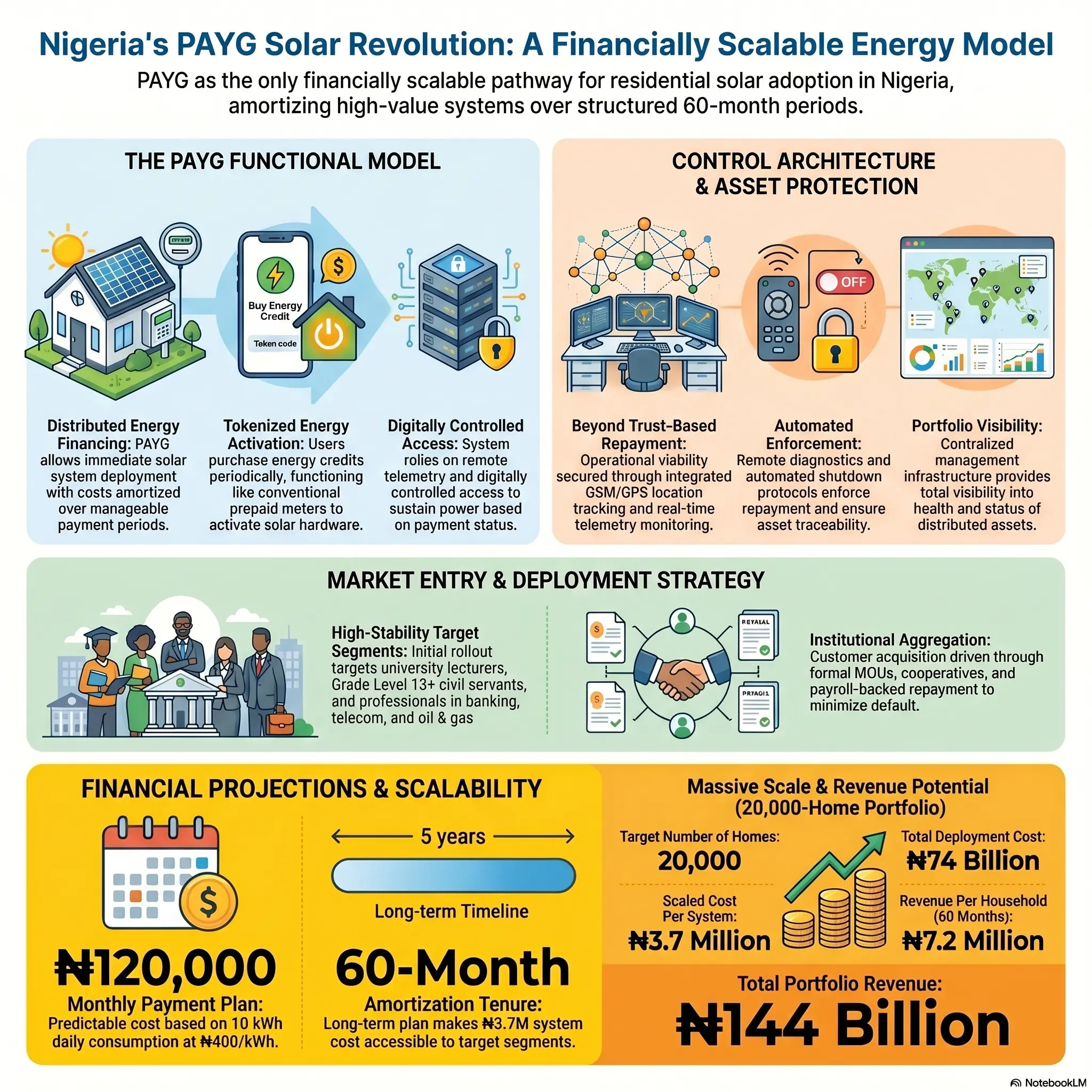
PAYG Solar is a distributed energy financing model that enables households to get stable and reliable immediately, while amortizing system costs over structured payment periods.
The system operates through:
Functionally, the system operates similarly to prepaid electricity metering. Users purchase energy credits that activate and sustain power access.
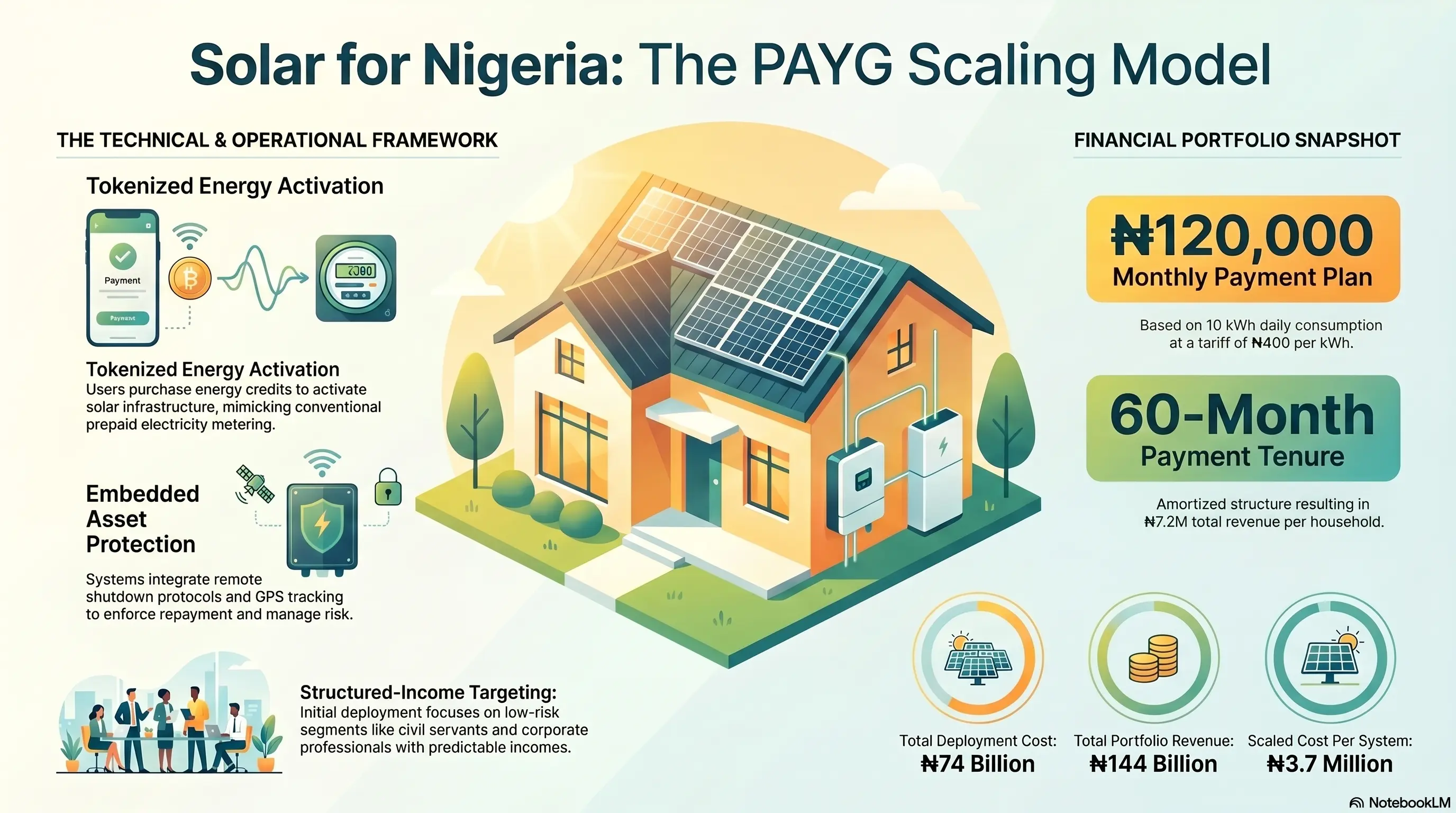
At an energy tariff of: ₦400 per kWh and average household consumption of: 10 kWh daily,
the payment structure becomes:
| Metric | Value |
|---|---|
| Daily Energy Cost | ₦4,000 |
| Monthly Energy Cost | ₦120,000 |
Deploying such high-value distributed energy assets into residential environments in Nigeria cannot rely on trust-based compliance alone.
The system and technical architecture must therefore integrate:
This ensures:
This model is not designed as an immediate mass-market rollout. Initial deployment is best optimized around: low-risk, structured-income segments.
Primary target segments include:
Customer acquisition should occur through:
The model is not fundamentally selling electricity to isolated individuals.
It is financing distributed energy infrastructure through institutions, cooperatives, and structured corporate ecosystems.
| Metric | Value |
|---|---|
| Number of Homes | 20,000 |
| Scaled Cost Per System | ₦3.7M |
| System Deployment Cost | ₦74B(20,000 * ₦3.7M) |
| Monthly Payment Plan | ₦120,000 |
| Payment Tenure | 60 Months(5 years) |
Revenue Per Home :
₦120,000 × 60 = ₦7.2M
Total Portfolio Revenue :
₦7.2M × 20,000 = ₦144B
Total Portfolio Revenue = ₦144B
| Category | Amount |
|---|---|
| System Deployment(20,000 homes) | ₦74B |
| Maintenance Reserve | ₦2.5B |
| Defaults & Loss | ₦3B |
| Operations/Admin/Compliance Reserve | ₦1.5B |
| TOTAL | ₦81B |
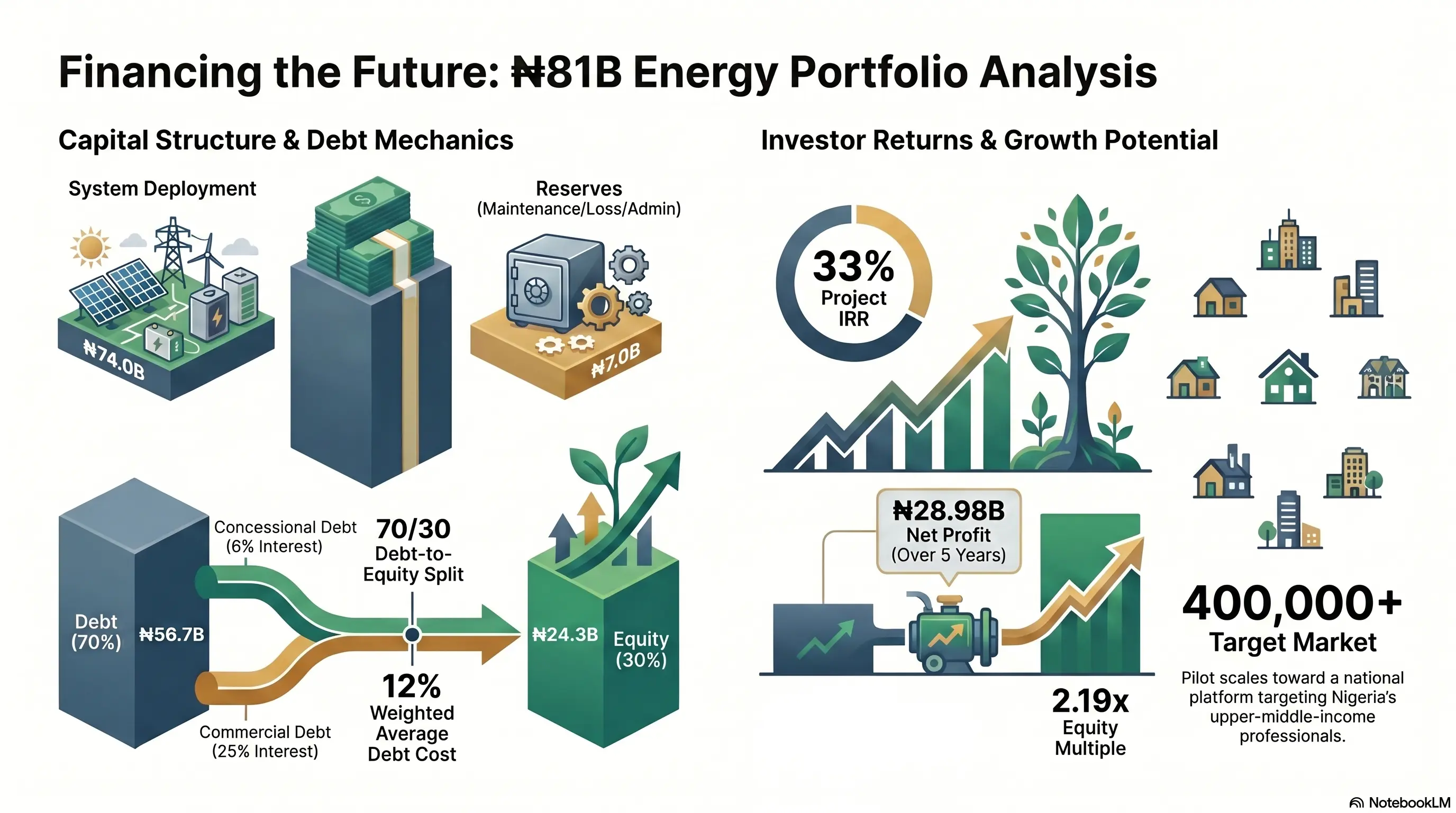
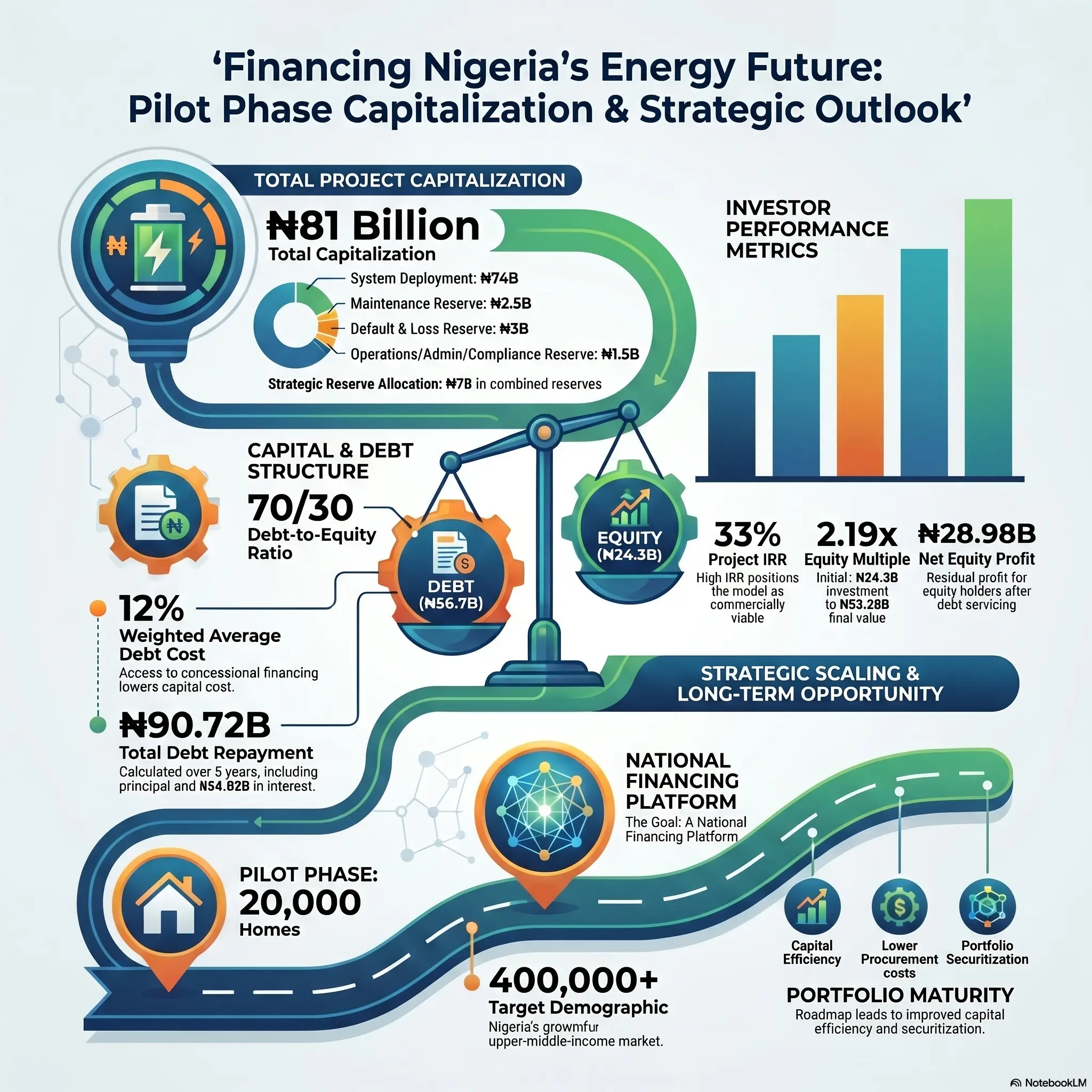
∴Total Capitalization/INVESTMENT = ₦81B
Deploying over ₦81B in distributed residential energy infrastructure, with cost recovery spread across a 60-month repayment cycle, creates major liquidity and capital-recycling constraints. As a result, Conventional cashflow financing alone is insufficient.
The model therefore requires blended financing, including:
The capital stack can therefore be structured as follows:
| Source | Amount | Share |
|---|---|---|
| Equity | ₦24.3B | 30% |
| Debt | ₦56.7B | 70% |
The financing structure depends on concessional and blended debt. Concessional financing enables access to:
Potential financing partners include the IFC, AfDB, and similar institutions.
| Debt Type | Share | Annual Interest |
|---|---|---|
| Concessional Debt | 70% | 6% |
| Commercial/Local Debt | 30% | 25% |
Weighted Average Debt Interest =
(0.7×6%)+(0.3×25%) ≈ 12%
Annual Interest Cost =
12% * ₦56.7B = ₦6.804B
∴ Annual Interest : ₦6.804B
Total Interest Over 5 Years
₦6.804B×5 = ₦34.02B
Total Debt Repayment(Debt + Total Interest)
₦56.7B + ₦34.02B = ₦90.72B
∴ Total Debt Repayment : ₦90.72B
Residual Equity Value
₦144B − ₦90.72B = ₦53.28B
∴ Final Equity Value = ₦53.28B
Net Equity Profit(Final Equity Value - Equity) :
₦53.28B − ₦24.3B = ₦28.98B
∴ Net Equity Profit = ₦28.98B
An ₦81B fully-capitalized distributed residential energy portfolio, generating total projected revenue of ₦144B over a 60-month repayment cycle, with a net residual equity value of ₦53.28B against an initial equity deployment of ₦24.3B, produces a projected net equity profit of ₦28.98B and an estimated modeled project Internal Rate of Return (IRR) of approximately 33%.
∴ IRR ≈ 33%
| Metric | Value |
|---|---|
| Initial Equity Invested | ₦24.3B |
| Final Equity Value | ₦53.28B |
| Net Equity Profit | ₦28.98B |
| Equity Multiple | 2.19x |
| Project IRR | 33% |
Annual Inflow
₦144B ÷ 5 = ₦28.8B
∴Annual Portfolio Inflow : ₦28.8B/year
| S/N | Metric | Final Value |
|---|---|---|
| 1. | Total capitalization | ₦81B |
| 2. | Equity | ₦24.3B |
| 3. | Debt | ₦56.7B |
| 4. | Cost Per Unit kWh | ₦400/kWh |
| 5. | Tenure | 60 Months(5years) |
| 6. | Number of homes | 20,000 |
| 7. | Total revenue | ₦144B |
| 8. | Total debt repayment | ₦90.72B |
| 9. | Residual to equity | ₦53.28B |
| 10. | Net equity profit | ₦28.98B |
| 11. | Project IRR | 33% |
This model assumes an optimized operational and execution environment, under which an estimated Internal Rate of Return (IRR) of approximately 33% positions the framework as:
However, key risks remain:
Critical questions therefore emerge:
As Long-term viability depends heavily on : low-cost capital access, disciplined execution, repayment performance, and operational scalability.
The larger opportunity extends beyond the initial 20,000-home deployment:
Nigeria conservatively possesses, 400,000+ UPPER-MIDDLE-INCOME PROFESSIONALS, within the target financing demographic.
This creates a significant long-term scaling opportunity capable of supporting phased national expansion across: salaried professionals, structured-income households, and institutionally aggregated residential clusters.
At scale:
Following pilot validation, the model can expand toward:
This would likely adopt variants of the financing and payment-enforcement systems deployed by East African platforms such as:
Long-term scalability also depends on reducing battery and inverter costs through:
This proposal became necessary after participating in a series of energy and power-sector discussions involving critical stakeholders across Nigeria’s electricity ecosystem, including engagements connected to the Federal Ministry of Power.
One of such engagements was a recent Public-Private Partnership (PPP) consultative forum held in Abuja, focused on infrastructure financing, power-sector sustainability, and long-term energy transition strategies.
From these conversations, it increasingly appears that Nigeria’s broader energy transition strategy is leaning heavily toward natural gas as an intermediate transition fuel. This position is largely driven by the belief that gas-based infrastructure:
Current national projections reportedly target:
However, based on historical infrastructure execution patterns within Nigeria, the structural bottlenecks across the power sector, the limitations and power crisis that have persisted even after power-sector privatization — with GenCos and Discos failing to meet operational benchmarks, it remains difficult to see centralized energy infrastructure alone resolving Nigeria’s electricity-access crisis at the speed and scale required.
This is where distributed PAYG solar infrastructure becomes increasingly relevant. While it may not independently solve Nigeria’s entire energy challenge, it has the potential to address a significant portion of the problem, particularly around: residential electricity access, affordability, energy reliability, and decentralized power availability for households and small businesses.
The urgency of this conversation is not theoretical, Over the past three months, I have spent roughly ₦12,000 on fuel daily to maintain basic electricity access.
This reflects the daily experience of millions of Nigerian households and businesses already informally financing their own private energy infrastructure through generators, diesel, petrol, and alternative power systems.
The question therefore is no longer whether Nigerians are already paying heavily for electricity.
The real question is:
HOW THOSE EXISTING ENERGY EXPENDITURES CAN BE REDIRECTED INTO SCALABLE, FINANCEABLE, PERFORMING AND SUSTAINABLE DISTRIBUTED ENERGY INFRASTRUCTURE.